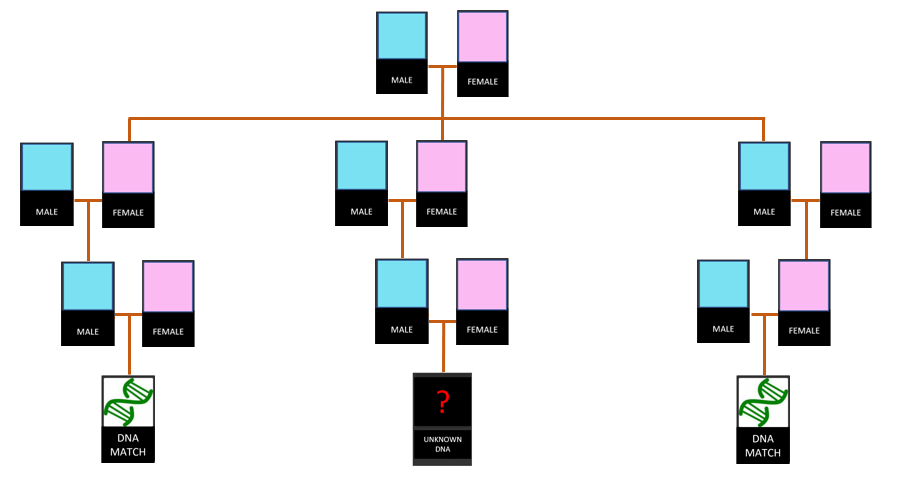
Investigative Genetic Genealogy (IGG) combines new DNA analysis techniques with traditional Genealogy (the study of family history & tracing of family lineages) to identify leads in criminal cases and unknown remains using commercial DNA databases.
Your DNA helps you learn more about your family. It could also help other families by solving some of WA's worst crimes.
IGG combines new DNA analysis techniques with traditional Genealogy (the study of family history & tracing of family lineages) to identify investigative leads and unknown remains using commercial DNA databases.
The technique involves uploading a crime scene or unidentified human remains DNA profile to one or more genetic genealogy databases in an attempt to identify genetic relatives and locate the unknown DNA profile.
Family trees are built back from genetic matches (often distant) to the unknown individual to identify common ancestors between the two or more. From the ancestors, family trees are built down into the present day to look for candidates for the unknown individual. This pool of candidates can be narrowed through location, age, context and physical description.
IGG produces intelligence leads in investigations where other avenues have been exhausted and no match exists on government DNA databases.
IGG methods can test up to 1 million ‘sites’ in an individuals DNA enabling the identification of much wider family relationships eg 3rd and 4th cousins.
We can only compare our unknown DNA profiles against the profiles of people who have “opted in” to allow law enforcement access.
Databases used by WA Police for IGG
IGG currently utilises two main consumer databases that are available to law enforcement:
The types of cases able to be uploaded by law enforcement are controlled by the terms and conditions of the databases, generally they include:
Homicides
Sexual assaults
Unidentified remains
Australians only make up around 5-10% of these databases.
WA Police cannot access or upload DNA profiles on other public DNA databases.
Ancestry, 23andMe and MyHeritage do not allow law enforcement comparison.
How you can help
Without the assistance of the public we would not have solved crimes and put names to the unidentified!
Increasing the amount of people, especially Australians on these databases is so important and gives us a better chance of success.
If you have submitted DNA to Ancestry, 23andMe, Myheritage or any other database and would like to assist WA Police Force and international law enforcement, it’s free and easy to upload your DNA data file to GEDmatch and FtDNA.
For instructions on how to download your DNA datafile and upload it to GEDmatch and FtDNA please click the links below.
How WA Police are using IGG
IGG has been successfully used by WA Police since 2023 on numerous cases including homicides, sexual assaults and unidentified human remains.
These identifications would not have been possible without the assistance of the public allowing law enforcement comparison to the unknown profiles.
Our policies and procedures mandate that once identified the DNA profile is removed from the database/s and regular reviews of the policy and the use of IGG are conducted.
Missing Persons
Missing person investigations utilise routine DNA testing to assist with identification. If you have a close family member missing (parent/child, sibling) and wish to discuss routine DNA sampling please contact the WA Police Missing Person Team (details below).
If your family member falls outside the parent/child/sibling group or if there is a possibility the missing person is overseas, we recommend you conduct DNA testing with a consumer database and upload the results to GEDmatch and FtDNA.
WA Police Missing Person Team [email protected] Ph: (08) 9267 5800 Staffed: Mon to Fri 0700 – 1500 (AWST)
FAQs
Why will sharing my DNA help you solve crimes?
Australians account for less than 5%-10% of the GEDmatch and FtDNA DNA profiles. If more Australians allowed law enforcement access it would increase the genetic matches we currently get and make identifying the unknown samples much quicker and easier.
I have an Ancestry account, can’t you just use that?
No, Ancestry does not allow comparison for law enforcement samples. You need to download your DNA data file and upload it to GEDmatch or FTDNA and opt in for law enforcement (your actual DNA and results still stay with Ancestry)
How much does it cost to allow law enforcement access?
Nothing, it’s free to create an account on GEDmatch or FtDNA and upload your DNA data file from your Ancestry / 23andMe / MyHeritage profile.
If I already have a GEDmatch or FtDNA account but didn’t allow law enforcement comparison, can I opt in or out?
When uploading your DNA to GEDmatch or FtDNA you have to ‘opt in’ to allow law enforcement to compare their unknown profile against yours. You can change your settings to opt in/out or remove you DNA data file at any stage by logging in to your account.
What details can law enforcement see? Do you have access to my DNA or medical records?
Law enforcement can only see the same match results as you see. It is only a data file that is uploaded and we can only see if you share any DNA with the unknown profile. There is no access to any medical records.
Do other companies allow law enforcement comparison?
GEDmatch and FtDNA are currently the 2 largest companies that allow law enforcement comparisons. There are other emerging companies which we may utilise once their databases grow.
Does this only help with Australian crimes or unidentified human remains?
No, these databases are used by law enforcement around the world! You might be the missing genetic link that helps unravel a mystery!
We acknowledge the traditional custodians throughout Western Australia and their continuing connection to the land, waters and community. We pay our respects to all members of the Aboriginal communities and their cultures; and to Elders both past and present.
Working Together by DuShong
The artwork titled ‘Working Together’ represents the Aboriginal tribes of Western Australia working together in harmony to rejuvenate the land by controlled fires.
In this artwork it also represents our community today working together to keep our neighbourhood safe from crime.